


At MAC in Yerevan, international marketer and entrepreneur Ashish Gaba took the stage to discuss autonomous AI agents, creative automation and the future of media buying. But for Gaba, who works across India, the UAE and Europe, the conference itself became just as interesting as the technology being discussed on stage.
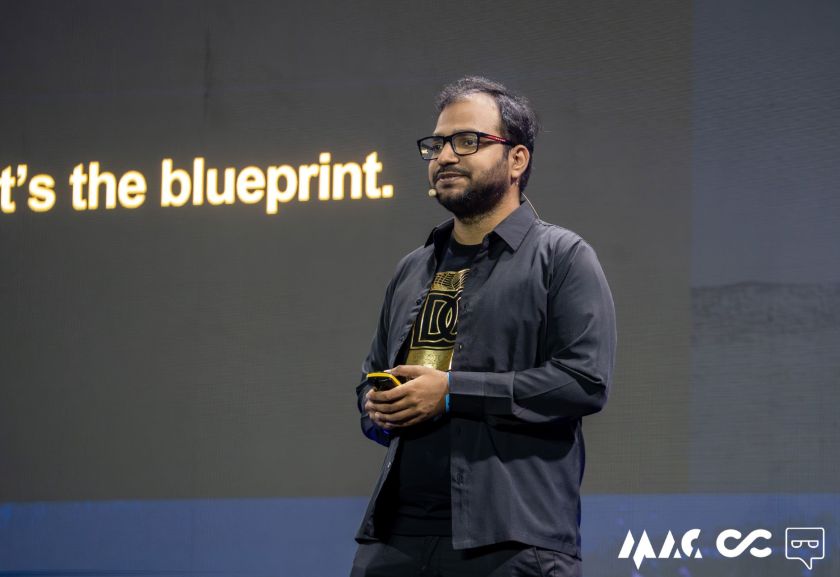
Ashish Gaba: “For a conference in Yerevan, the density of nationalities per square meter was impressive.”
The conversation around artificial intelligence in performance marketing has moved quickly.
Not long ago, AI was primarily used to generate copy, images or campaign ideas. Today, the industry is already experimenting with systems capable of launching campaigns, analysing performance, reallocating budgets and generating new creative iterations with increasingly limited human intervention.
This was the focus of Ashish Gaba’s talk at MAC, the international iGaming & Affiliate Conference in Yerevan.
Gaba, who works across advertising, digital products and AI and splits his time between India, the UAE and Europe, spoke at MAC on “Autonomous AI Agents and Infinite Creatives: Media Buying on Autopilot.”
His central argument was clear: fully autonomous media buying may not be here yet, but the transition is already well underway.
“Agents today can already run the full loop on execution: launch tests, read signals, kill losers, scale winners, and even brief creative iterations,” Gaba said.
In his estimation, such tasks already account for around 70% of a media buyer’s working day.
What machines still struggle with is less mechanical.
Taste. Context. Strategy. Understanding why a certain message will resonate in a particular market. Recognising when the numbers are technically correct but leading the team toward the wrong conclusion.
Gaba expects the balance between human and machine to shift significantly over the next two years.
“Within 18 to 24 months, one senior buyer with agents will do the work of a five-person team,” he said. “The human doesn’t disappear. The human becomes the editor-in-chief.”
The real AI conversations are not happening in whitepapers
That idea also shaped Gaba’s view of industry conferences.
For professionals working in AI, advertising technology and creative scaling, he argues that the real value of events such as MAC is not simply access to another set of presentations.
It is access to the people currently testing technologies before those practices become mainstream.
“The people experimenting hardest with AI in media buying right now aren’t publishing whitepapers,” Gaba said. “They’re at events like MAC, comparing notes over coffee.”
That exchange of practical knowledge became one of his strongest impressions of the conference.
According to Gaba, professionals attending MAC could walk away not only with broader industry observations but with concrete ideas they could start testing immediately after returning to work.
A conference in Yerevan with a genuinely international audience
As someone who operates across several major markets, Gaba also paid close attention to the international composition of MAC.
His verdict was straightforward.
“Genuinely international.”
During a single afternoon, he said, his conversations covered the CIS region, the Gulf, Europe and India.
“For a conference in Yerevan, the density of nationalities per square meter was impressive.”
That diversity also exposed him to companies and business models he had not previously encountered.
The CIS affiliate ecosystem in particular was largely new territory for Gaba. During MAC, he met Russian- and Ukrainian-speaking teams as well as COD networks operating in GEOs where he had never previously bought traffic.
For him, this is one of the key differences between MAC and the conference circuit that international executives already know.
“It’s not the same 200 faces you see at every other show.”
That matters in an industry where conferences can easily become repetitive: the same companies, the same meetings and the same conversations moving from one city to another.
MAC, in Gaba’s experience, opened access to another part of the global performance ecosystem.
Where the first meeting happens — and where the business happens
MAC welcomed more than 5,000 attendees, a scale at which meaningful networking can easily become difficult.
Gaba nevertheless found the interaction unusually accessible.
“Usually at that scale you lose people in the crowd, but MAC’s layout and culture keep speakers, buyers and networks in the same spaces,” he said.
One detail stood out to him in particular: speakers remained accessible rather than being separated from the rest of the audience.
The result, he said, was the ability to have proper conversations instead of two-minute introductions.
“Deals happen when people can talk for 20 minutes, not two.”
At the same time, Gaba does not draw a strict line between the official conference and the events taking place around it.
In his view, they perform different functions.
“The venue is where you find the person; the surrounding events are where you close them.”
The initial contact may happen on the expo floor. The more meaningful discussion often follows over dinner, at a side event or somewhere else in the city.
This wider conference ecosystem became one of his strongest memories of MAC.
The talks were valuable, he said, but the relationships were often built in the conversations surrounding them.
Yerevan itself also played a role.
“The city has warmth that big conference hubs have lost.”
Can MAC become a bridge between India, the UAE, Europe and the CIS?
Gaba believes MAC has an opportunity that extends beyond simply increasing attendance.
Its potential, in his view, lies in connecting markets that are individually growing quickly but are not yet consistently brought together by one industry platform.
India, the UAE and the CIS region are all highly active performance-marketing markets.
Yet there is still no single conference that fully connects those ecosystems.
Gaba believes MAC could occupy that position.
“MAC is geographically and culturally positioned to be that connector.”
For the conference to expand that international role, however, he believes MAC should build its presence in those markets before attendees ever arrive in Yerevan.
One route would be to create MAC-branded side events around major international conferences in Europe and the UAE.
The second is exhibitor curation.
International buyers, he argues, will travel when they know the offers, networks and partners relevant to their actual business will be present.
He pointed specifically to the continued importance of COD e-commerce in the European affiliate market and the potential value of bringing more US nutra networks into the ecosystem.
“When buyers know the offers they scale will be represented, the flight books itself.”
More than another 5,000-person trade show
For Gaba, however, MAC’s strongest advantage is not something that can be created simply by increasing the number of exhibitors.
Plenty of conferences can fill an exhibition hall.
What is harder to create is a distinctive culture.
“MAC isn’t a corporate trade show, it’s an experience,” he said.
The conference, side events, hospitality and Yerevan itself combine into something that feels larger than an expo.
“Plenty of shows have 5,000 people. Very few have 5,000 people who leave feeling like they lived something together.”
That, he believes, is MAC’s edge.
It is also what the organisers need to protect as the conference becomes increasingly international.
Gaba has seen other events grow from community-driven gatherings into large corporate exhibitions dominated by sponsorship inventory and sales booths.
He believes MAC should avoid the same trajectory.
“MAC still feels like it’s built by people who love this industry,” he said. “Growth is great, but the moment it starts optimizing for sponsors over community, it becomes just another show.”
His advice for the next stage of MAC’s development is therefore surprisingly simple: preserve its soul.
What comes next: agentic media buying
Gaba already knows what he would like to discuss if he returns to the MAC stage.
The next step would be less theory and more evidence.
He wants to go deeper into agentic media buying, breaking down campaigns operated end-to-end by AI agents and showing exactly where human intervention was still required.
A live examination of what autonomous systems can genuinely handle today — and where they still fail.
In other words: fewer predictions, more receipts.
And would he return?
“Absolutely.”
Asked to describe MAC in just three words, Gaba chose: “Dense, global, addictive.”
His final description was even more direct: “One MAC and it’s on your calendar forever.”
Perhaps his most fitting analogy, however, came when he was asked to complete one sentence: “I would return to MAC for…”
Gaba answered: “…the same reason you rewatch your best converting creative. You know exactly what happens, and it still hits every time.”


